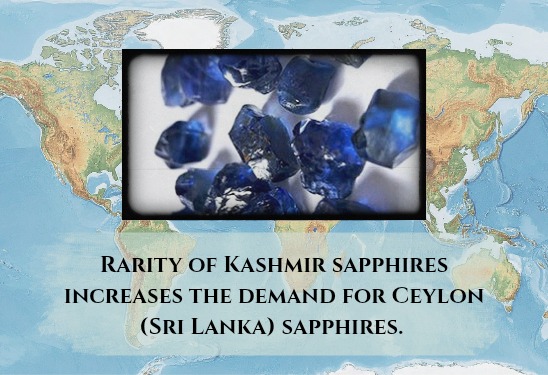
The global blue sapphire market is increasingly shaped by a clear and irreversible reality: Kashmir sapphires are no longer being produced in any meaningful commercial quantity, while Ceylon, now Sri Lanka, continues to supply fine blue sapphires to the world. This contrast between absolute scarcity and steady availability is redefining how collectors, experts, jewelers, and investors view blue sapphires, not only in terms of beauty but also legacy, value, and long-term significance.
KASHMIR BLUE SAPPHIRE
Kashmir blue sapphires occupy a singular position in gem history. Discovered in the late 19th century in the high-altitude regions of the Himalayas, these sapphires were mined intensively for a short period before the deposits were largely exhausted. What emerged from those mines were stones of extraordinary character, distinguished by their legendary velvety blue color caused by fine rutile silk. This soft, glowing texture remains unmatched and has become the benchmark by which all blue sapphires are judged.
Today, the absence of new Kashmir production has elevated these stones beyond gemstones into historical artifacts. The extreme rarity of Kashmir sapphires means that every mention of a Kashmir sapphire immediately captures the keen interest of experts. Auction houses, gemological laboratories, historians, and collectors pay close attention whenever a stone with credible Kashmir origin appears in the market. Each stone carries not just intrinsic beauty, but a finite and unrepeatable story tied to a vanished source.
ZANSKAR CROWN SAPPHIRE
This heightened interest is evident in recent narratives surrounding historically important stones. The Zanskar Crown Sapphire, worn by Maharaja Pratap Singh in a lavish necklace, has featured in few reports and social media posts in recent times. Its story highlights how Kashmir sapphires are no longer evaluated purely on carat weight or clarity, but on provenance, royal association, and historical context. Such stones function as cultural symbols, representing power, prestige, and a bygone era of natural abundance that can never be replicated.
CEYLON (SRI LANKA) SAPPHIRES
In contrast, Ceylon sapphires present a different but equally important narrative. Sri Lanka has been a continuous source of sapphires for over two millennia, producing stones admired for their brilliance, transparency, and wide range of blue hues. Unlike Kashmir sapphires, Ceylon stones are not defined by extreme scarcity, but by consistency, trust, and sustained excellence. This steady flow has allowed Ceylon sapphires to remain central to both fine jewelry and popular culture.
One of the most famous Ceylon sapphires is the oval blue sapphire once worn in an engagement ring by the late Lady Diana. This sapphire, now worn by Catherine, Princess of Wales, exemplifies the enduring appeal of Ceylon stones. Its global recognition demonstrates how Ceylon sapphires have shaped modern perceptions of elegance and romance. While not rare in the same sense as Kashmir sapphires, iconic Ceylon stones gain value through visibility, association, and emotional resonance.
CEYLON AND KASHMIR SAPPHIRES
As the sapphire market moves forward, these two origins (Kashmir and Sri Lanka) are increasingly viewed as complementary rather than competitive. Kashmir sapphires dominate the uppermost tier of the collector market, where rarity, documentation, and historical importance matter more than availability or design flexibility. Their prices continue to rise steadily, driven by the certainty that no new supply will emerge. Each transaction further reinforces their status as blue-chip gemstones, comparable to museum-quality art or historic diamonds.
Ceylon sapphires, meanwhile, anchor the broader sapphire market. Their steady availability ensures that fine blue sapphires remain accessible for high jewelry houses, bespoke designers, and private collectors. Improvements in mining practices, cutting standards, and gemological transparency have further strengthened confidence in Ceylon origin stones. Exceptional Ceylon sapphires, especially untreated stones with strong color and clarity, continue to command impressive prices, even if they do not reach the rarified levels of Kashmir sapphires.
SAPPHIRES, LOOKING AHEAD
Looking ahead, the absence of new Kashmir stones will likely intensify scholarly research, provenance verification, and storytelling around existing stones. Each Kashmir sapphire will increasingly be viewed as a historical record rather than a commodity. Publications, exhibitions, and expert analyses will play a crucial role in preserving and contextualizing these gems for future generations.
At the same time, Ceylon’s continued production ensures that blue sapphires remain relevant in contemporary jewelry and culture. The ability to source beautiful, natural blue sapphires allows designers to innovate and keeps consumer interest alive. This balance between legend and continuity is what ultimately sustains the sapphire market as a whole.
In a world without new Kashmir sapphires, their mystique only deepens. In a world with a steady flow from Ceylon, the beauty of blue sapphires remains visible, wearable, and alive. Together, these two realities define the future of blue sapphires, where rarity fuels reverence and continuity ensures relevance.