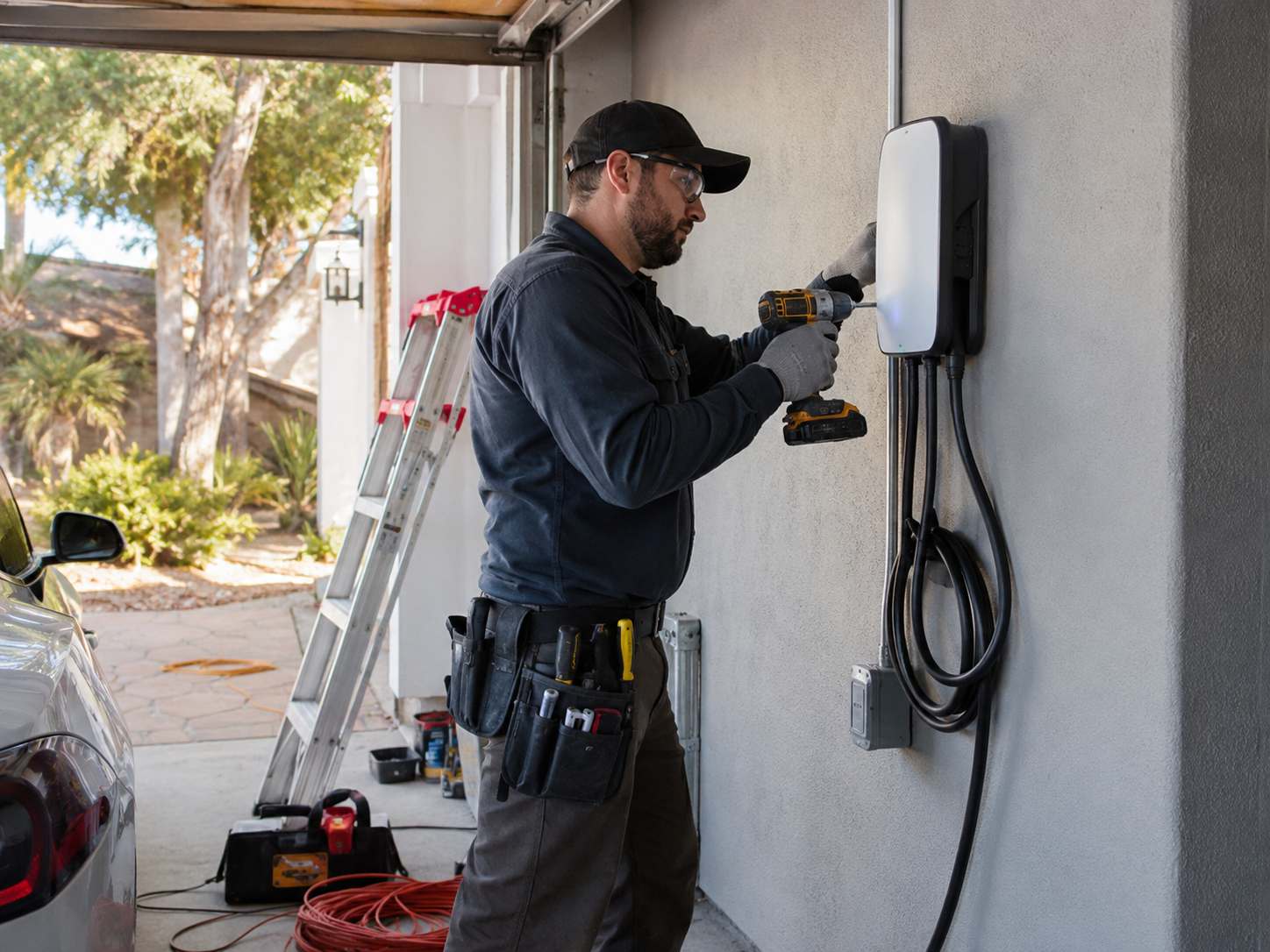
If you are planning to install a Level 2 EV charger at your Toronto home, one of the first questions to answer is whether your existing electrical panel and service have enough capacity for the additional load.
The short answer is: you cannot determine EV charger capacity from the panel size alone. A Licensed Electrical Contractor should consider your electrical service rating, existing household loads, actual or calculated electrical demand, the output of the proposed charger, and the condition of the existing electrical system. Toronto Hydro specifically advises homeowners to have their existing electrical capacity assessed before installing home EV charging equipment. If you are considering home EV charging and want your existing electrical system assessed, you can learn more about professional installation at https://xboct.ca/ev-charger-installation/.
A 200-amp service is therefore not automatically required for a Level 2 EV charger. Depending on your home’s existing demand and the charger you want to install, a 100-amp or other existing service may still be workable. If capacity is limited, options such as reducing the charger’s configured output or installing an approved energy management system may sometimes avoid a full service upgrade. Ontario’s Electrical Safety Authority recognizes energy management systems as a method of controlling EV charging loads.
What Determines Whether Your Panel Can Handle an EV Charger?
Several factors need to be reviewed before deciding whether your electrical system can support Level 2 charging.
1. Your Home’s Electrical Service Rating
Start by identifying your home’s electrical service size.
Toronto houses may have different service ratings depending on their age and previous electrical upgrades. The rating is commonly identified at the main disconnect or main breaker, but knowing that number alone does not tell you how much unused electrical capacity is available.
For example, two homes with the same service rating can have very different electrical demands.
One home may use natural gas for heating, hot water and cooking, while another may have electric heating, an electric range, electric water heater, hot tub, air conditioning and other significant loads.
That is why the service rating should be considered together with the home’s actual or calculated demand.
2. Your Existing Electrical Load
The next question is how much electricity the home already requires.
An EV charger adds another significant electrical load to the property. Toronto Hydro notes that installing equipment such as an EV charger can increase a home’s electrical demand enough to require an upgrade in some cases—but not in every case.
A contractor may evaluate electrical capacity using an applicable load calculation and, where permitted, demonstrated historical electrical demand. ESA’s current EV charging guidance specifically addresses calculations used to determine whether an existing dwelling service requires an upgrade when EV charging equipment is added.
Toronto Hydro also provides residential customers with a peak-demand tool that can help homeowners and Licensed Electrical Contractors understand how much electricity the property has historically used at one time.
3. The Output of the Level 2 Charger
Not every Level 2 EV charger places the same demand on an electrical system.
Level 2 home charging generally operates at 240 volts, but the charger’s configured charging current can vary depending on the equipment and installation. Toronto Hydro identifies Level 2 charging as a 240-volt home charging option and notes that electrical upgrades may be necessary depending on the home’s existing capacity.
This is important because your electrical system does not necessarily need to support the maximum possible output of every charger on the market.
Some approved fixed-in-place EV charging equipment can be configured to operate at a lower maximum current when installed according to the manufacturer’s requirements and applicable electrical rules. ESA’s current EV charging bulletin specifically addresses adjustable EVSE settings and the conditions under which those settings can be used when determining circuit loading.
For many homeowners, the practical goal is not simply to install the highest-amperage charger possible. It is to choose a charging configuration that provides enough overnight charging for the vehicle while remaining appropriate for the home’s electrical capacity.
Does Having an Empty Breaker Space Mean I Have Enough Capacity?
No.
An empty breaker position in the panel means there may be physical room for another circuit breaker. It does not automatically mean that the electrical service has sufficient capacity for an EV charger.
These are two different questions:
Panel space: Is there room for the required circuit protection?
Electrical capacity: Can the home’s service safely accommodate the additional electrical demand?
A panel can have empty breaker positions while the home’s available service capacity is limited. Conversely, there may be ways to address limited physical panel space without increasing the electrical service size.
A proper EV charger assessment should consider both issues.
Can a 100-Amp Panel Handle a Level 2 EV Charger?
Potentially, yes.
Having a 100-amp electrical service does not automatically mean you need to upgrade to 200 amps before installing an EV charger.
Whether the installation is practical depends on the home’s existing loads, historical or calculated demand, charger requirements and the charging configuration being proposed.
ESA guidance specifically provides methods for determining whether an existing dwelling service needs to be upgraded when EV charging equipment is added rather than treating an upgrade as automatically necessary in every installation.
This is why homeowners should avoid assuming either that a 100-amp service is sufficient or that a 200-amp upgrade is mandatory before an electrical assessment has been completed.
Could Load Management Help If My Panel Is Near Capacity?
Yes, in appropriate installations.
An Energy Management System, often referred to as an EMS or EV load-management system, can monitor electrical usage and control the EV charger based on the capacity available.
For example, the system may reduce or temporarily interrupt EV charging while other large electrical loads are operating and allow charging to increase again when capacity becomes available.
Ontario’s Electrical Safety Authority permits qualifying Energy Management Systems to control EV charging loads and provides specific rules governing how those loads are treated when calculating electrical demand.
For a Toronto homeowner whose existing service is close to its available capacity, this can sometimes provide an alternative to a larger electrical-service upgrade.
Whether load management is appropriate depends on the existing electrical system, charger, equipment being used and installation design.
How Can I Check My Panel Before Calling an Electrician?
You can gather several pieces of information that will make the initial EV charger assessment easier.
Take clear photos of:
- the entire electrical panel;
- the main breaker or service rating;
- the panel directory or circuit labels;
- the electrical meter;
- the proposed EV charger location; and
- the approximate route between the panel and the charger.
You should also identify the EV charger model you are considering and, if possible, its maximum charging output.
Toronto Hydro customers can also review their historical electricity usage and peak demand through Toronto Hydro’s online tools. Peak demand is particularly useful because it shows the highest amount of electricity the home has used at one time and can help a Licensed Electrical Contractor determine whether additional service capacity may be required.
These steps can help with an initial assessment, but they do not replace the electrical calculations and site-specific evaluation required for the actual installation.
What If My Electrical Panel Cannot Support the Charger?
Finding that your existing electrical system cannot support the proposed charger at its original configuration does not necessarily mean the project cannot proceed.
Depending on the property, possible solutions may include:
- selecting an appropriate charger output;
- configuring compatible fixed EV charging equipment to a lower approved output;
- installing an Energy Management System;
- modifying the proposed electrical design;
- replacing or upgrading an outdated electrical panel; or
- upgrading the electrical service where additional capacity is genuinely required.
ESA recognizes both adjustable fixed-in-place EV charging equipment and qualifying energy-management approaches under specified conditions.
The correct solution depends on the house rather than on a universal rule.
Why the Charger Model Should Be Chosen Before the Final Electrical Design
It is helpful to know which charger you plan to install before the electrical work is finalized.
The contractor needs to know the charger’s electrical requirements, maximum output, installation instructions and whether it will be hardwired or connected through an approved receptacle.
ESA also advises homeowners to look for a recognized Canadian electrical product approval mark when purchasing EV charging equipment.
Choosing the charger first—or at least narrowing the choice to a few models—allows the electrical installation to be designed around the actual equipment rather than assumptions.
Do I Need a Licensed Electrical Contractor in Toronto?
For an EV charger installation, homeowners should work with a Licensed Electrical Contractor.
Toronto Hydro specifically recommends using a Licensed Electrical Contractor to assess a home’s electrical capacity and determine appropriate charging options.
ESA also states that a Licensed Electrical Contractor must file the required Notification of Work before starting an EV charger installation and provides the Certificate of Acceptance once the completed work has been accepted as compliant.
XB Electric assesses factors such as electrical-service capacity, existing loads, charger requirements, wiring distance and whether load management or additional electrical work may be necessary before the installation is finalized.
Frequently Asked Questions
How do I know if my panel has enough power for a Level 2 EV charger?
The most reliable method is to have a Licensed Electrical Contractor evaluate the home’s service rating, existing electrical loads and the requirements of the proposed charger. Historical peak demand or an applicable electrical load calculation can help determine whether sufficient capacity exists.
Do I automatically need 200-amp service for an EV charger?
No. Whether a service upgrade is required depends on the home’s existing electrical demand and the EV charging load being added. Toronto Hydro specifically notes that new equipment such as an EV charger may require a service upgrade, but not always.
Can an EV charger be installed on a 100-amp service?
It may be possible. The answer depends on the home’s available electrical capacity, existing loads, charger output and installation design. A load assessment should be completed before deciding that an upgrade is necessary.
Can load management avoid a panel or service upgrade?
In some homes, yes. A qualifying Energy Management System can control EV charging based on available electrical capacity, and Ontario’s electrical rules provide for the use of EMS equipment with EV charging systems.
Is an empty breaker slot enough to install an EV charger?
No. Empty panel space does not establish that the electrical service has sufficient capacity. Both physical breaker space and overall electrical demand need to be evaluated.
Final Answer
So, how do you know whether your electrical panel can handle a Level 2 EV charger in Toronto?
Have the home’s electrical capacity evaluated against the actual charger you plan to install. The service rating, existing household demand, charger output, panel condition and available circuit capacity all matter.
A 100-amp service does not automatically require an upgrade, and a 200-amp service does not eliminate the need for an assessment. Where capacity is limited, load management or an appropriately configured charger may sometimes provide another solution.
The goal should be to install an EV charging system that matches both your driving needs and the electrical capacity of your Toronto home.