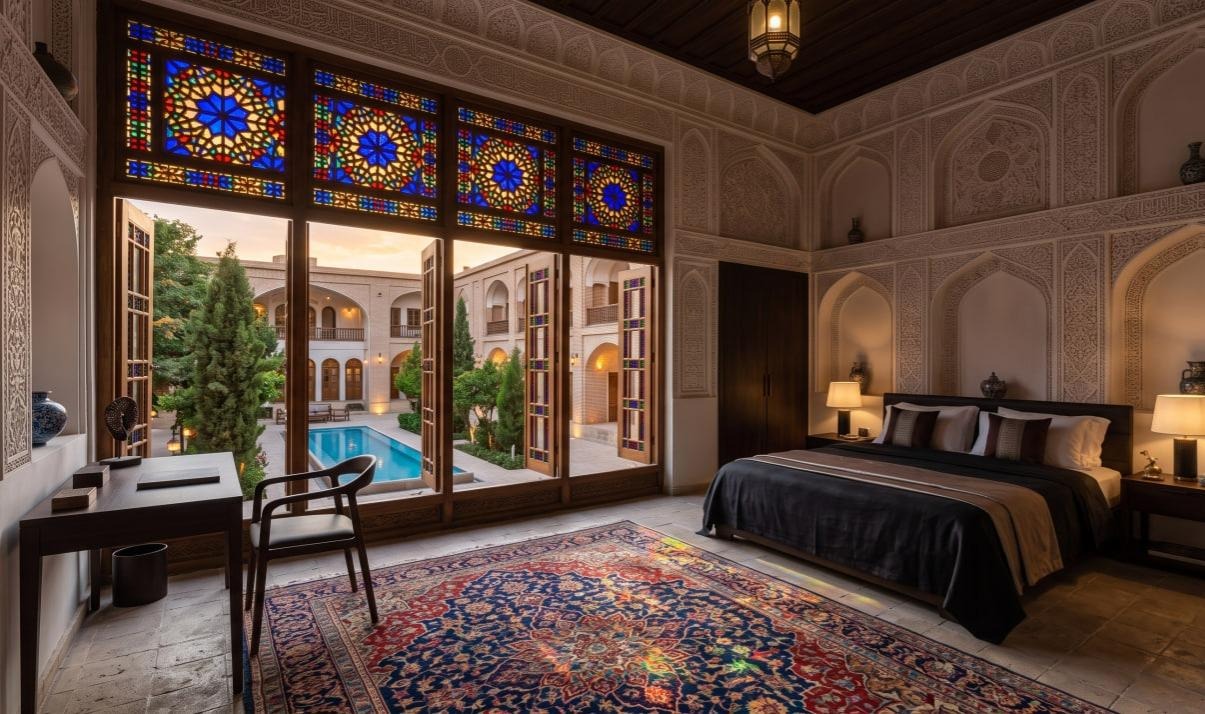
Modern luxury travelers increasingly reject generic high-rise accommodations in favor of authentic, culturally immersive spaces. In historic Iranian cities like Kashan and Isfahan, century-old aristocratic mansions have undergone meticulous restoration to become ultra-luxury historic boutique hotels. Properties such as Saraye Ameriha preserve traditional architectural integrity while offering premium amenities tailored to discerning international guests. This comparative analysis examines how these restored heritage estates provide a superior, sustainable luxury experience compared to standardized modern skyscrapers. Understanding the spatial design of these properties allows premium travelers to optimize their cultural journeys through the Iranian plateau.
Why Choose Historic Boutique Hotels Over Modern Luxury Skyscrapers?
Historic boutique hotels in Iran offer a distinct advantage over generic modern skyscrapers by providing deep cultural immersion, superior microclimatic comfort through passive engineering, and unmatched architectural individuality. While modern high-rises rely on uniform steel structures and energy-intensive HVAC systems, restored Persian mansions utilize high thermal mass materials, secluded courtyards, and artisanal craftsmanship. This structural philosophy ensures that every guest suite delivers an authentic historical narrative alongside five-star luxury amenities.
The Architectural Anatomy of Restored Kashan and Isfahan Mansions
The transition of grand residential estates into elite hospitality venues requires preserving complex spatial layouts designed during the Safavid, Zand, and Qajar eras. In Kashan, Saraye Ameriha stands as the premier example, spanning 9,000 square meters with multiple distinct courtyards, making it the largest converted residential structure in the country. Similarly, Isfahan features historic properties like the Bekhradi Historical House and Kianpour Boutique Hotel, where spatial distribution emphasizes structural privacy and aesthetic refinement.
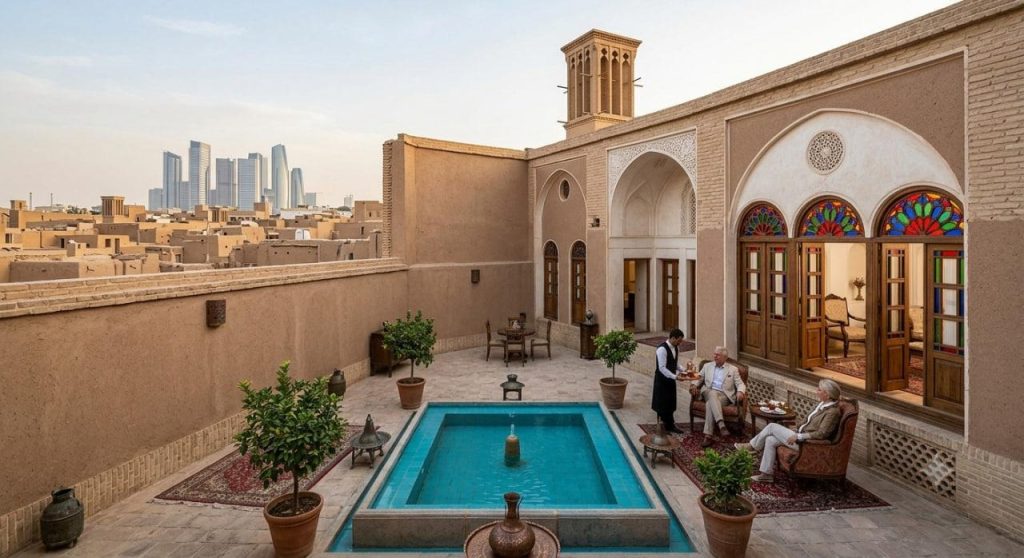
Traditional Persian mansions are systematically organized around specific zoning and artistic features:
- Andaruni and Biruni Separation: The strict division between internal private quarters and external reception spaces translates perfectly into exclusive guest zones and private luxury suites.
- Artisanal Surface Finishes: Instead of the standardized drywall found in skyscrapers, rooms feature intricate gypsum plasterwork, Muqarnas vaulted ceilings, and hand-cut mirror mosaics (Aineh-kari).
- Orosi Windows: Large sash windows fitted with geometric woodwork and vibrant stained glass filter the harsh desert sunlight into soft, multicolored interior illumination.
Microclimatic Comfort: Passive Persian Engineering vs. High-Rise HVAC
The contrast between a modern glass tower and a restored historical mansion is most evident in climate control efficiency and acoustics. Skyscrapers rely on sealed glass facades that absorb massive solar radiation, requiring continuous, noisy mechanical cooling systems to remain habitable. In contrast, historic Iranian mansions use ancestral passive engineering to achieve a stable, completely silent indoor temperature.
The operational differences between these two luxury accommodation models are detailed below:
| Feature | Restored Persian Mansion Hotel | Modern Luxury Skyscraper |
|---|---|---|
| Primary Building Material | High thermal mass adobe, clay brick, and plaster | Low thermal mass steel, reinforced concrete, and glass |
| Climate Control Method | Passive badgirs (windcatchers) and subterranean qanat pools | Mechanical HVAC compressors and forced-air ducts |
| Acoustic Environment | Secluded, inward-facing courtyards filtering city noise | Ambient mechanical hum from ventilation and elevators |
| Spatial Configuration | Unique, non-repetitive room layouts and custom alcoves | Homogenous, modular room configurations and corridors |
Navigating Premium Bookings for Historic Stays
Securing accommodations within these exclusive properties requires navigating localized luxury hospitality networks. Because these historic boutique estates limit their room inventories—often maintaining fewer than 30 suites to preserve structural integrity—early reservation is essential for premium travel seasons.
Discerning international travelers can utilize comprehensive digital booking resources to evaluate specific suite layouts, courtyard views, and heritage amenities. Consulting an authentic Iran hotel booking guide via trusted regional booking platforms like Eghamat24 simplifies the process, offering verified access to historic mud-brick accommodations right in the heart of Yazd, Kashan, or Isfahan. This approach guarantees verified placement in authentic architectural masterpieces while ensuring modern luxury standards are met.
Conclusion
The transformation of ancient mansions in Kashan and Isfahan represents a paradigm shift in the global premium hospitality sector. By choosing carefully restored heritage properties over homogenous concrete towers, international travelers directly support cultural preservation and sustainable tourism. These elite boutique estates prove that historical authenticity and modern five-star comfort can coexist seamlessly within an architectural masterpiece. Planning a stay through verified reservation platforms ensures a seamless bridge between ancient heritage and modern luxury.
Frequently Asked Questions
1. What defines an ultra-luxury historic boutique hotel in Iran?
An ultra-luxury historic boutique hotel is a meticulously restored aristocratic residence or palace from the Safavid, Zand, or Qajar eras. These properties combine original historical architecture, hand-crafted artwork, and inward-facing courtyards with five-star hospitality services, premium dining, and modern room amenities.
2. Do these restored heritage properties feature modern en-suite bathrooms and air conditioning?
Yes, all top-tier historic boutique hotels undergo comprehensive infrastructure upgrades during restoration. Rooms are equipped with modern premium bathrooms, highly effective hidden air conditioning units, high-speed Wi-Fi, and electronic safes without compromising the historic fabric of the building.
3. Which historic boutique hotel is considered the largest in Iran?
Saraye Ameriha Boutique Hotel in Kashan is the largest traditional house converted into a luxury hotel. Spanning 9,000 square meters, it contains several large courtyards, 27 customized suites, two restaurants, an art gallery, and the highest windcatcher tower in the city.
4. How do historic Persian mansions manage noise compared to skyscrapers?
Unlike skyscrapers that suffer from mechanical HVAC hums, historic mansions are designed with inward-facing architecture and thick adobe walls. This structural design entirely isolates guest rooms from external street traffic and city noise, creating a completely silent courtyard oasis.
5. What is the best season for international travelers to visit Kashan and Isfahan?
The premium seasons are autumn (September to November) and spring (March to May), when desert temperatures are mild. Because boutique properties have highly limited room counts, advanced booking via local networks is necessary during these peak months.